
My Oil Vanished. My Lips Cracked.
Cold, dry air changes your face within a day. It changed my routine far less than a shelf full of winter creams suggests it should.

RayCo-Founder & Editor
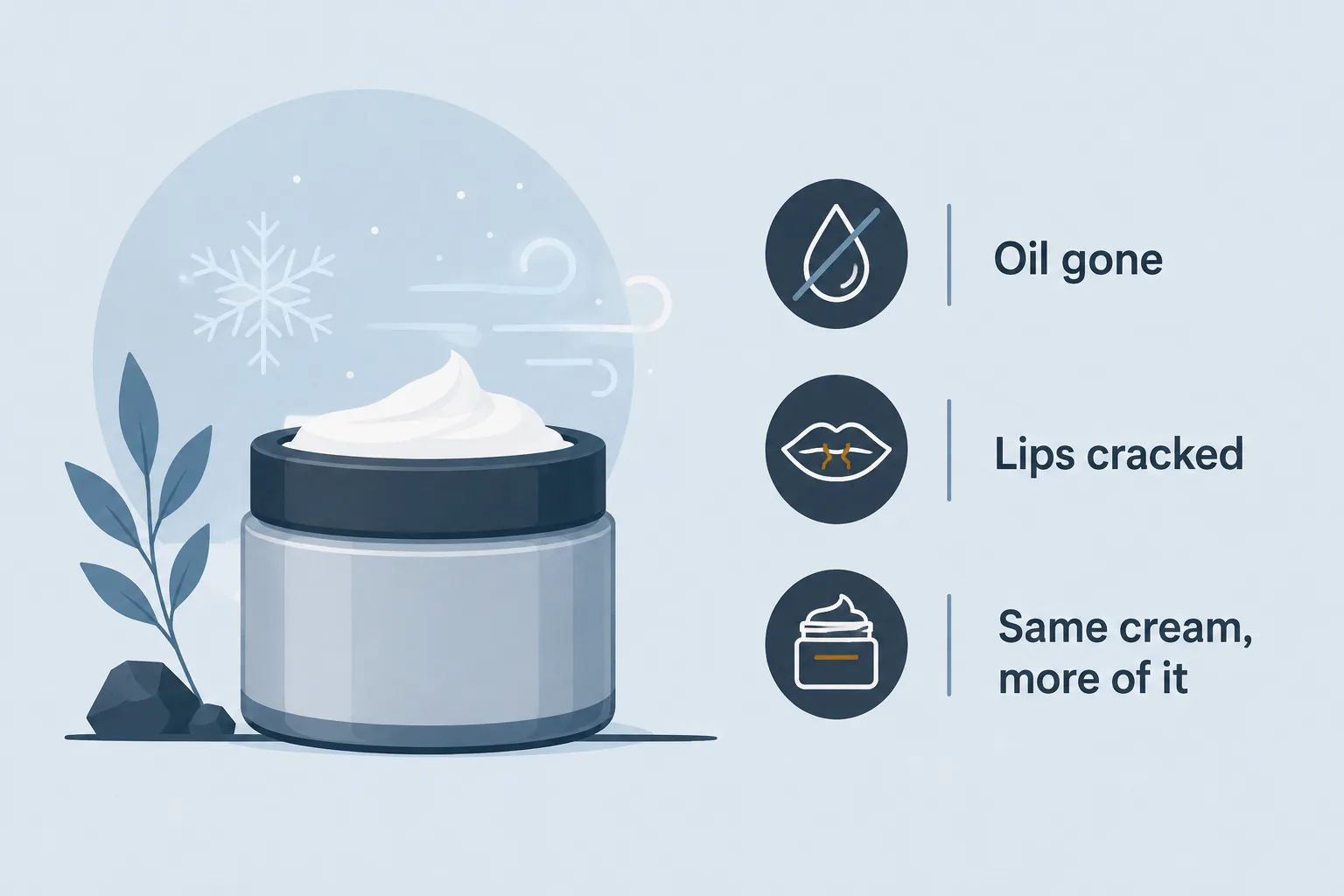
The short version: Cold, dry air changes your face fast — for me it takes about a day. My oil disappears completely, my skin feels tight, and my lips crack badly enough to bleed. What I did about it is less than the shops would like: I kept the same routine and the same cheap moisturizer, used more of it, and bought a lip balm. That's the whole change. If you're being told you need a winter cream, a winter cleanser and a winter serum, you're being sold a season.
What happens when the air gets dry?
I live somewhere hot and humid, so I don't get a slow slide into winter. I get it in a day.
Fly to Japan or Hong Kong in spring, or to Korea in the actual cold, and the change lands almost immediately. The oil goes first. I'm the guy whose blotting sheet used to go transparent in two swipes by lunchtime, and in dry air that stops entirely. Not reduced. Gone.
Then the skin on my face starts to feel tight — not sore, not itchy, just noticeably pulled. I never scratch. Nothing flakes off visibly.
And then my lips split. That's the part that actually hurts. They crack and they bleed, reliably, and it happens faster than anything else on my face. In Singapore I have never once owned a lip balm. The moment I land somewhere dry I need one, and if I've forgotten to pack it I'm buying one that day.
Getting a whole season in a three-day dose has one advantage: cause and effect are impossible to miss. If you live somewhere with a real winter, this same change happens to you across October and November so gradually that you're unlikely to connect it to anything. You just notice, sometime in December, that your face isn't behaving.
Why does dry air do this?
Because there's less moisture in the air to hold onto, and your skin loses its own faster.
Cold air carries less water than warm air. Then you go inside, where the heating is on, and it gets worse rather than better — indoor heating routinely pushes humidity below 30%, when skin is generally happier somewhere around 50%. So there's no part of a cold day where your face gets a break. Outside is dry, inside is drier.
That's the whole explanation and you don't need more of it than that.
Does oily skin protect you?
This is the part I'd want to know, because most of the people reading this site have oily skin and are quietly looking forward to a few months off.
The honest answer is that I don't fully know, and here's why.
The research says dry air can make you oilier, not less oily. The reasoning is that when the air pulls moisture out of your skin, your skin responds by producing more oil, which then has the usual consequences — clogged pores and breakouts. That's a mechanism the American Academy of Dermatology has described, and there are dermatologists who'll tell you winter acne is a real and common thing. Cold is also a physical stress, and stress reliably makes inflammatory skin conditions worse.
My own experience is the opposite. My oil doesn't increase in dry air. It disappears.
I can't reconcile those two things and I'm not going to pretend I can. It may be that a few days is too short for the compensating effect to show up. It may be that I'm unusual. It's one person, in a handful of trips, which is not evidence of anything general.
What matters is that both roads lead to the same instruction. If your skin dries out and stays dry, you moisturize more. If your skin dries out and responds by overproducing oil, you also moisturize more, because the dryness is what started it. There is no version of this where the answer is "wash your face harder," which is the instinct I've written about being wrong before.
So: no, don't assume oily skin gives you a free pass. But don't buy anything new on the strength of that either.
Do you need a different moisturizer for winter?
Probably not. You likely need more of the one you have.
This is where I'd expect to lose an argument with a shop assistant, so let me be specific about what I actually did. My moisturizer is a Torriden DIVE-IN Soothing Cream — Korean, about eight dollars, and by any reasonable description a light one. Not a thick winter cream. Not something sold for barrier repair.
I took it to Korea in winter. It held up fine. I didn't get flaking, I didn't get raw patches, and I didn't at any point think "I need to buy something heavier." What I did was put on noticeably more of it, more often.
The standard advice from dermatologists is to switch to a thicker, cream-based moisturizer for winter, and I'm not going to tell you they're wrong — they're describing a whole season, and I've had weeks. If you're four months into a Canadian winter and a light cream has stopped coping, believe your own face over my trip.
But the order matters. Use more of what you own first. It costs nothing, it takes one day to find out, and it works often enough that a lot of people buy a winter cream they never needed. If it genuinely isn't enough after a couple of weeks, then go heavier — and you'll be buying it because you have evidence, not because it's October.
That's the same argument as the three products I actually recommend. More stuff is rarely the fix.
What about air conditioning?
I expected this to be the same problem in tropical clothing, and for me it isn't.
I spend most of my day in air conditioning — office, malls, cars, it's unavoidable here. I don't feel my skin drying out anything like as fast as it does abroad. I notice nothing comparable to a day in Seoul.
I'd have liked that to be a neat parallel, because it would mean everyone gets dry-air exposure year-round and the article writes itself. It just isn't what happens to me. Air-conditioned air in a humid place still seems to have more in it than heated air in a cold one.
If you're in a climate like mine, I wouldn't spend money solving a problem I can't feel.
Where my evidence runs out
I want to be clear about this, because it's the weakest part of what I can tell you.
I have had winter in weeks, not in seasons. Korea in the cold, Japan and Hong Kong in spring, and home to the tropics afterward. I have never lived through four straight months of it, never run a heater through a whole December, and never had to deal with what that does by February.
I also have skin that's never reacted badly to anything, which I've said before is luck rather than skill. If you have genuinely dry skin, or eczema, or anything that already cracks and splits without help from the weather, my experience is not a useful guide and a doctor's is.
What I can tell you honestly is what changed for me, how fast, and what fixed it. That's it.
What I'd actually tell you to do
- Start moisturizing more before it gets cold, not after. The change happens faster than you'll react to it. If you wait until your face feels tight, you're already behind.
- Use more of your current moisturizer first. Twice the amount, twice a day, for two weeks. That's the experiment, and it's free.
- Buy a lip balm now. This is the one thing I actually had to add, and it's the cheapest item in this entire routine. Lips crack before anything else and they hurt more than anything else.
- Don't wash more or hotter because you feel greasy-free. You aren't cleaner in winter, you're drier. A gentle cleanser matters more now, not less — the same one you should already be using.
- Go easier on anything strong. If you use retinol, dry weather is when it's most likely to tip you into flaking. Drop a night if you need to. Nothing bad happens.
- Keep wearing sunscreen. Cold and overcast is not the same as safe, and this is the exact reasoning that cost me years.
- Only buy a heavier cream if the free experiment fails. Two weeks of using more, then decide. In that order.
If you live through a real winter and a light moisturizer stops holding, I'd genuinely like to know — that's the part of this I can't test from here.
Filed under
One note on transparency: no brand mentioned on this site is sponsoring us, and we don’t use affiliate links. Everything we recommend is something we’ve personally used. Nothing here is medical advice. If any of that changes, you’ll hear it from us first.
Don't miss the next one
New articles straight to your inbox. No spam, no fluff — just what actually works.
Free. Unsubscribe anytime.