
The Damage I Couldn't See
I skipped sunscreen for years because I never burned. Then a machine at a shop counter showed me what was already there.

RayCo-Founder & Editor
For years I didn't wear sunscreen. I'd never burned badly, my skin looked fine, and every bottle I'd ever tried felt like a punishment. So I skipped it.
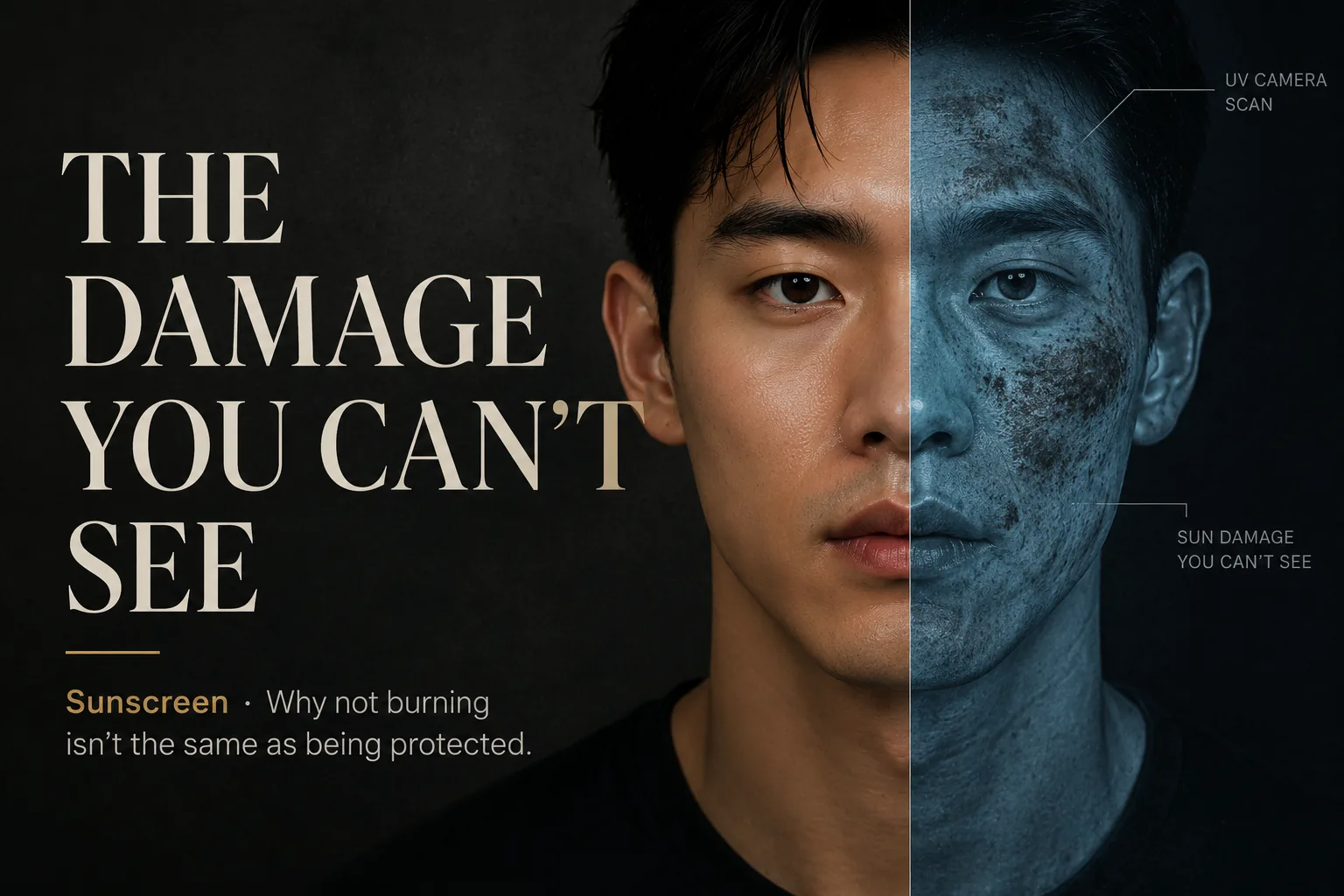
Then I walked into a Kiehl's counter and used their free skin scan — the machine that photographs your face under a different kind of light and shows you what's sitting underneath the surface.
Mine came back with severe sun damage.
Not on my face. Under it. Nothing I could see in a mirror, nothing anyone else could see either, all of it accumulated over years I'd spent thinking I was fine because I hadn't gone red.
The short version: if you don't burn, you're not protected — you're just not being warned. Get a lightweight sunscreen you'll actually wear, put it on every morning, and you've done the single highest-value thing available to your skin.
Why you never thought you needed it
Here's the trap, and it's specific to us.
Burning is a warning system. Skin that goes lobster-red after an afternoon outside is telling you, loudly and immediately, that something is wrong. It's unpleasant, but it's information.
Skin that tans instead doesn't send that signal. You go outside, you go slightly darker, nothing hurts, and your brain files it as fine. But the ultraviolet light did the same work either way. The difference is that you never got the alarm.
That's why the advice never landed. Sunscreen gets sold on sunburn, and sunburn was never your problem. What was actually happening was slower and quieter: uneven tone, dark marks that hang around for months after a spot has healed, and skin aging faster than it needed to.
I found out about mine from a machine at a shop counter. That's a stupid way to learn it, and it's why I'm writing this.
Why every sunscreen you tried felt awful
This part surprised me, and it isn't your fault or the brand's. It's regulatory.
In the United States, sunscreen is legally a drug. The ingredients that do the actual sun-blocking have to clear the same approval bar as medication — a full safety dossier, years of review. In Korea and Japan, sunscreen is regulated as a cosmetic. Ingredients still have to be proven safe, but the path is faster.
The consequence is that Asian brands have had access to newer, more comfortable sun-blocking ingredients for decades while American ones were stuck with the same short list.
How stuck? Until June this year, the US hadn't added a single new sunscreen ingredient to its approved list since the late 1990s. One was finally approved a couple of months ago — an ingredient that had been in Korean and European bottles for years.
So when people say Asian sunscreens feel better, that's true, but it isn't magic or superior chemistry. Their regulators simply let newer ingredients through. The gap is finally starting to close, roughly thirty years late.
This is also why the sunscreen aisle in a Western pharmacy feels the way it does: thick, chalky, and built for a beach rather than a Tuesday.
The one I stopped using
Before my current one I used Derma Lab UV Reflect, and it taught me what to avoid.
Two problems. It left a white cast — that gray, ashy film that sits on top of your face and announces itself in every photo. And once it dried, if I rubbed my face at all, white dust came off. Actual visible debris, on my fingers, on my collar.
That's not a small annoyance. That's a product you stop wearing, and a sunscreen you don't wear protects nothing at all. The best formula on paper is worthless if it makes you look gray and sheds on your shirt.
What I use now
Bio-Essence Bio-Water Sunscreen, about $16, ten months in.
The difference is the texture. It's watery rather than thick — it goes on more like a light moisturizer than a cream, sinks in, and disappears. No white cast. No dust. Nothing to rub off onto anything.
The thing I care about most, living where I live: it holds up against sweat and it doesn't run into my eyes. If you've had sunscreen sting your eyes on a hot day you know why that matters — that's the experience that makes people quit sunscreen permanently, and it's usually the formula's fault rather than yours.
What did it actually do? Nothing visible, which is the honest answer and the point of the whole product. There's no glow-up week. What I did notice, months in, was less redness and irritation after being out in the sun. Everything else it's doing is invisible — it's the damage that doesn't accumulate, the marks that don't darken. You're paying now to avoid a problem later.
What to look for when you buy
You don't need my exact bottle. You need one you'll wear every day. Four things to check:
Texture, not brand. You want watery, light, fast-absorbing. If a tester feels heavy on the back of your hand, it will feel worse on your face at 2pm.
Test the white cast in daylight. Not under shop lighting, which is designed to flatter. Put some on your hand, step outside, look.
SPF 50, and look for the PA rating. Most Asian sunscreens print a "PA" followed by plus signs. Those pluses measure protection against the rays that cause aging and dark marks, rather than burning. Four pluses is the most you'll see, and it's what you want.
Rub it after it dries. The Derma Lab lesson. If anything comes off on your fingers, it will come off on your collar.
If you're buying in the US, two Asian sunscreens are easy to find and widely liked: Beauty of Joseon Relief Sun (about $19) and Biore UV Aqua Rich (about $13). I haven't run either for months the way I have mine, so I won't pretend to review them — but both are lightweight, neither is known for a white cast, and either beats not wearing any.
The part where I'm honest about reapplying
Every guide tells you to reapply every two hours. Here's what I actually do: I don't.
My schedule is the reason. I sleep through much of the day and my work runs from late afternoon into the night, so my genuine sun exposure is low. One application in the morning covers what I'm actually exposed to.
I'm telling you this because the alternative — pretending I follow the textbook — would make everything else here less believable.
But be honest about your day, because it's probably not mine. If you commute in daylight, eat lunch outside, or work anywhere near a window for hours, one morning application isn't covering you by mid-afternoon. Reapplying over a face you can't wash is genuinely awkward, which is why sunscreen sticks and sprays exist. They're less pleasant than the morning application but far better than nothing.
And on indoor days: I wear it sometimes, not religiously. The textbook answer is that windows let through the aging rays even when they block the burning ones, so you should. The honest answer is that on a day I don't leave the house, I often skip it. Somewhere between those two is where most people actually live.
If you only do one thing
Of the three products I'd start anyone on, this is the one with the highest return, and it's also the one people abandon first — because it shows you nothing. There's no before-and-after. Just an absence of damage you'll never get to see.
I found out what a decade without it looks like from a machine at a shop counter. You don't have to find out that way.
See you gents in the next post.
Filed under
One note on transparency: no brand mentioned on this site is sponsoring us, and we don’t use affiliate links. Everything we recommend is something we’ve personally used. Nothing here is medical advice. If any of that changes, you’ll hear it from us first.
Don't miss the next one
New articles straight to your inbox. No spam, no fluff — just what actually works.
Free. Unsubscribe anytime.