
Everyone Sells It for Wrinkles. I Bought It for My Nose.
Retinol is marketed as a problem for later. I started at 27, for something on my nose — and how you start matters far more than what you buy.

RayCo-Founder & Editor
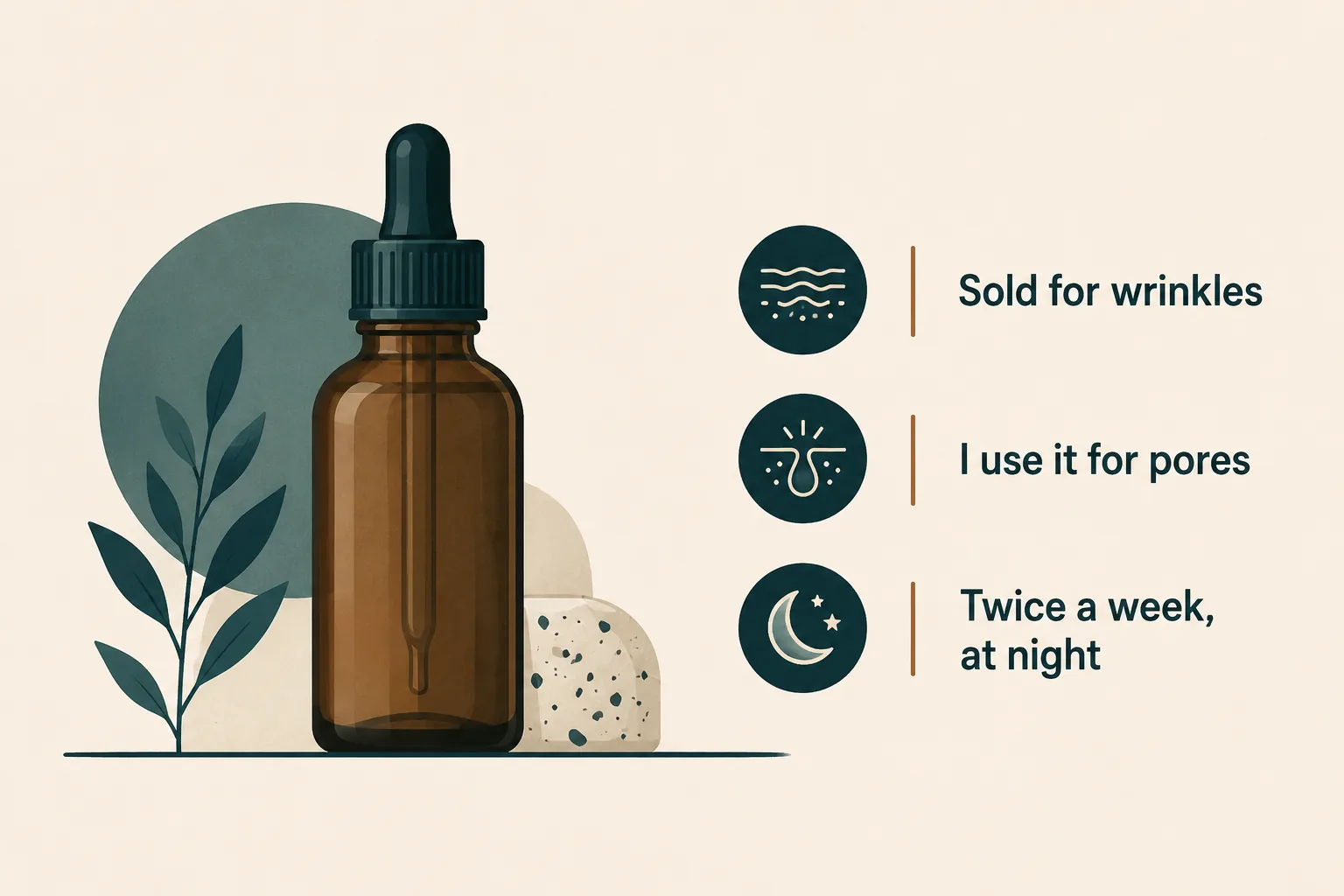
The short version: Retinol is sold almost entirely as an anti-aging product, which is why most men my age file it under problems for later. I'm 27 and I've used it since March — not for lines, but for the clogged-looking pores on my nose. It works slowly. You put it on at night, twice a week to start, and you should not expect to see much for a couple of months. The mistake that costs people isn't buying the wrong bottle. It's going too hard, too fast, and irritating skin that marks easily.
What is retinol, in plain English?
Retinol is a form of vitamin A that you put on your skin.
What it does, in the only terms that matter to you, is speed up how fast your skin replaces its surface. Pores clog less. Marks clear sooner. Rough patches smooth out. That is the entire pitch, and almost everything else written about retinol is decoration on top of that one sentence.
There are two versions worth knowing about. There's the kind you can buy — drugstore, Korean brand, whatever your local shop stocks. That's what I use, and it's what this article is about. Then there's the prescription kind, which a doctor gives you and which is many times stronger than anything sitting on a shelf. If you have real, persistent acne, that second one is a conversation with a doctor, not a shopping decision. I've never used it and I'm not going to pretend to know how it feels.
Why would you use retinol at 27?
Because I wasn't buying it for my face getting older. I was buying it for my nose.
The dots on my nose are sebaceous filaments, not blackheads, and I spent about fifteen years trying to scrub, strip and squeeze them away before I understood that. What actually moves them is a routine you run every day, and retinol kept coming up as part of that routine.
You should know where my advice comes from. I have never seen a dermatologist in person. Everything I follow here comes from Dr. Muneeb Shah, a board-certified dermatologist who posts as DermDoctor to an audience in the tens of millions. He also founded Remedy, which makes the cleanser I recommend. Nobody pays me and there are no affiliate links on this site, but my face wash and my retinol advice trace back to the same man, and you should weigh both knowing that.
The reason I didn't start sooner is boring: it was expensive. For years retinol was the thing you read about rather than the thing you owned. The products were newer, pricier, and mostly not stocked anywhere I shopped. That has genuinely changed. Nearly every brand now sells some version of it, the price came down, and it stopped being a specialist purchase. If it feels like retinol is suddenly everywhere, that's because it is — and that's a supply story, not a breakthrough.
I've deliberately bought cheap ones. I started with Some By Mi, and I'm on an Olay now. Neither was a commitment; both were me finding out whether my skin tolerated this at all before spending properly. I'm planning to switch to something better and I haven't picked it yet, which I'd rather say than invent a recommendation.
How often should you use retinol?
The advice I followed — Shah's again — is to start at twice a week and slowly build from there. I followed the first half of that and quietly ignored the second.
I've been at twice a week since March, and I never graduated. On the other nights I use my exfoliating toner or my regular toner pads instead, so the retinol slots into a rotation rather than taking over. That's below what most guides treat as a real routine. Most of them present twice a week as a beginner setting you're supposed to grow out of.
I didn't grow out of it, and my nose still improved.
I'm not telling you twice a week is optimal, because I don't know that. What I'm telling you is that the version of this you can actually keep doing for six months beats the version you abandon in three weeks with a flaking face. That's the same argument I've made about doing one thing instead of nothing, and retinol is where it matters most, because retinol punishes enthusiasm.
Use it at night, and only at night. That's the one part of this I'd state flatly rather than hedge. It isn't that daylight is dangerous — it's that sunlight breaks retinol down, so putting it on in the morning mostly wastes it.
How long does retinol take to work?
Longer than you want. Plan for months, not weeks.
Most people see the first visible changes somewhere between four and twelve weeks — texture, tone, fewer clogged pores. The slower results, like fading marks and softening lines, are generally described in the research as three to six months of consistent use.
The first couple of weeks can run in the opposite direction. Dryness and light flaking are common while your skin adjusts. That phase is where most people quit, and quitting there is the worst possible outcome, because you took all of the downside and none of the payoff.
Do not add retinol in the same month you change anything else. I've made this mistake across my whole routine and I've written about it before: I still can't tell you which product fixed my nose, because I changed several things at once. Add one thing, run it for three months, then decide.
Does retinol cause dark marks?
This is the part I'd want to know if I were you, and the answer cuts both ways.
Retinoids are one of the standard treatments for the dark marks left behind after a spot. They're genuinely good at it. But retinol irritation — the redness and flaking from going too strong too fast — can itself leave a mark on skin that marks easily. So the same product can either fade the thing you're worried about or cause a new one, and the difference is entirely how you start.
Here's the part that surprised me, and it's worth being precise about. The research doesn't say our skin is more likely to get irritated by retinol. That's not the finding. What it says is that when irritation does happen, the mark it leaves behind is more noticeable and hangs around longer on skin with more pigment in it.
So the risk isn't that this is riskier for us. It's that the consequence lasts longer. Marks on my face clear in about two weeks and marks on my body take months — I'd rather not hand myself an avoidable one on the fast-healing half.
Which is a long way of saying: start at twice a week and mean it.
Do you need sunscreen with retinol?
Yes — but the reason you've been given is probably wrong.
The usual line is that retinol makes you burn more easily. It doesn't. Retinol isn't the kind of ingredient that reacts with sunlight on your skin. What actually happens is that a faster-renewing surface is a newer, thinner, more vulnerable surface, so the sun does more damage to it over time.
The practical answer doesn't change. If you're using retinol you need sunscreen every day, and if you weren't going to wear sunscreen anyway, retinol is a strange place to start spending money. I ignored sunscreen for years on the grounds that I never burned, and a free in-store skin scan showed me what was underneath. Burning was never the measure.
What I can't tell you
I can't prove retinol did anything for me specifically, and I'd rather be straight about that than sell you a result.
My whole routine is aimed at one problem, so several things are running at my nose at once. What I can tell you is that the order is cleaner than I made it sound yesterday. My Moringa serum ran for roughly six months on its own before retinol joined it in March. So the serum still gets the credit I gave it — it had a head start, and my nose improved during it. Retinol is the newer variable, running about five months now, on top of something that was already working.
Would I recommend it anyway? Yes. Not because I ran a clean experiment on my own face, but because keeping your skin turning over is what stops pores re-clogging, and that's what the rest of my routine is trying to do anyway. It's the most sensible fourth product I could have added.
Fourth. Not first.
What I'd actually tell you to do
- Don't start here. If you don't have a cleanser, a moisturizer and a sunscreen running daily, retinol is the wrong purchase. Start with the three and come back in a few months.
- Buy a cheap one first. You're finding out whether your skin tolerates it, not committing to a brand. I've used two supermarket-tier ones and I'm still deciding on my third.
- Twice a week, at night. Stay there far longer than you think you need to. There is no prize for getting to every night.
- Give it three months before judging it. And don't change anything else in that window, or you'll end up where I am — better skin, no idea what earned it.
- Sunscreen every day, no exceptions. Otherwise you're speeding up renewal and then damaging the new surface.
- If it stings, flakes or goes red, back off. Drop to once a week, or stop for two weeks. Pushing through irritation is how you end up with a mark that outlasts the problem you were treating.
- Prescription strength is a doctor's call. Not a stronger thing to buy online.
I'll tell you which brand I move to once I've picked one, and whether it makes any difference I can actually see. Given how long this stuff takes, don't hold your breath before Christmas.
Filed under
One note on transparency: no brand mentioned on this site is sponsoring us, and we don’t use affiliate links. Everything we recommend is something we’ve personally used. Nothing here is medical advice. If any of that changes, you’ll hear it from us first.
Don't miss the next one
New articles straight to your inbox. No spam, no fluff — just what actually works.
Free. Unsubscribe anytime.