
Four Bottles, Two Problems
I switched between four cleansers chasing the same two problems. The fix wasn't a fifth one.

RayCo-Founder & Editor
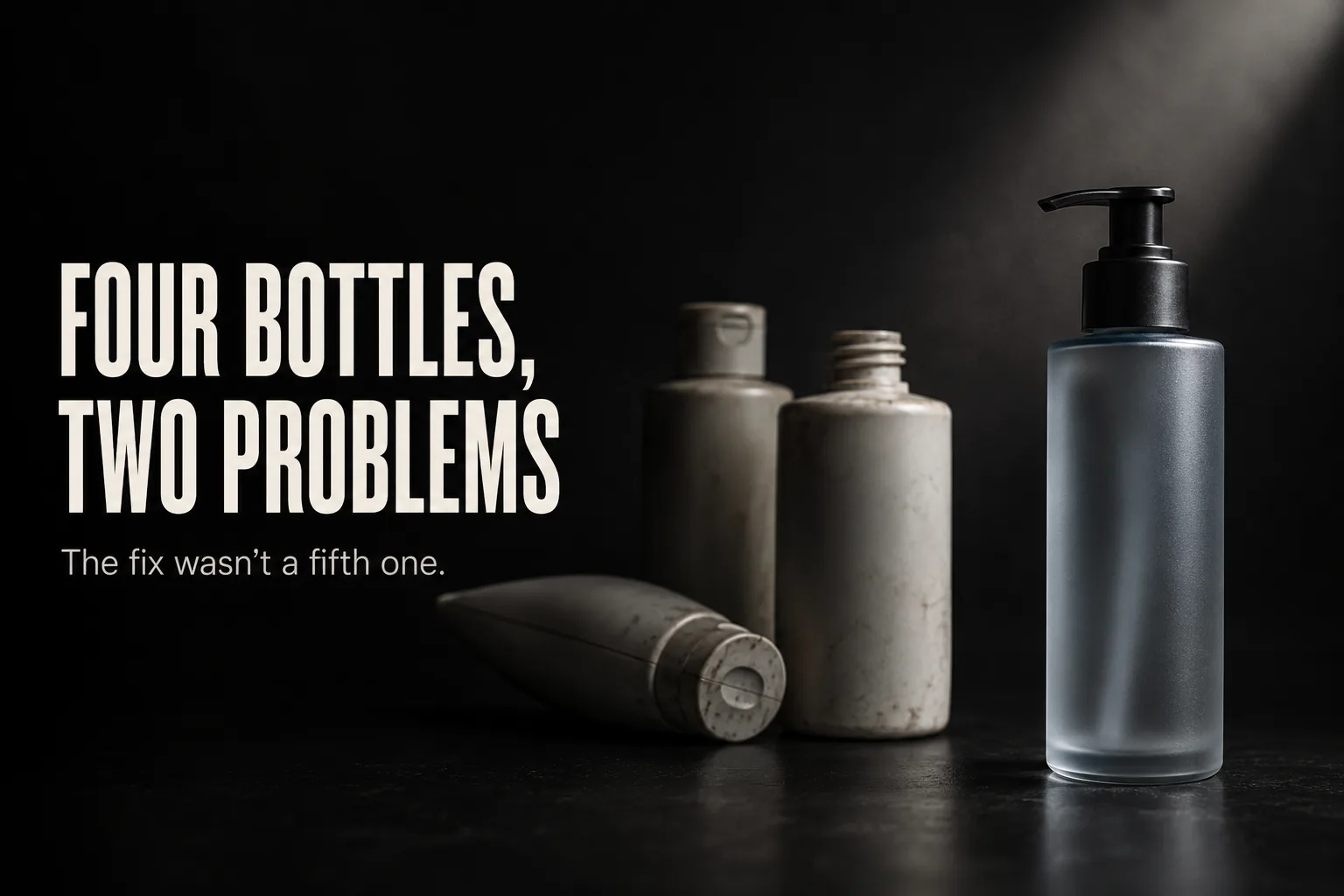
There are four cleansers in my bathroom history and only one of them has ever come close to being finished.
Nivea Men. Senka. Neutrogena. I rotated through all three across a few years, and the reason was always the same: my face was oily, the pores around my nose bothered me, and every time a bottle didn't fix that, I decided the answer must be the next bottle.
It wasn't. The answer was picking one for a reason and staying on it long enough to find out.
The short version: cleanser is the cheapest thing in your routine and the first one you'll feel working. Don't wash your face with soap. Don't scrub it. Wash twice a day if you're oily, and give one bottle three months before you decide anything — I gave each of my first three about six weeks, which is nowhere near enough.
I kept buying the next bottle
The switching was the problem. Not a sign of the problem — the problem itself.
A bottle would last a month or two, my nose would look the same in the mirror, and I'd take that as my answer. It isn't an answer. Skin changes slowly, and six weeks of anything barely tells you a thing.
There was a bigger mistake underneath it, though. All three of those cleansers were doing the same general job. None of them were picked for my pores specifically. I kept changing the answer without ever deciding what the question was.
What I use now: Remedy Lightweight Gel Cleanser. I bought it for one reason — it's made for oily skin and clogged pores, which is exactly what I have.
Two months in, here's what's actually different. My face is less oily through the day. The pores around my nose are noticeably less obvious. My skin feels cleaner in a way the supermarket ones never delivered.
Not perfect — nothing makes a pore smaller, and anything promising you that is selling you a story. But it beats three years of switching, and it came from making one decision, once, for one reason.
The thing in your shower is not a face wash
The only times I've put soap on my face were in hotel bathrooms, traveling, having forgotten to pack something better. It went badly every time — redness, and skin that felt raw for the rest of the day.
Soap is built to strip oil off your hands and your body. Your face isn't built to take that.
Researchers recently tested 250 different cleansers sold on shelves, and every single true soap in the batch came back far harsher than facial skin wants. Not most of them. All of them, without one exception.
So the rule is about the object, not the brand: if it's soap, it doesn't go on your face. Not the bar, not body wash, not shampoo, not the little bottle in the hotel bathroom.
This is the cheapest fix in the whole routine. You're not spending more money, you're just stopping doing something actively unhelpful.
What "clean" is supposed to feel like
This is the most useful thing in this article, so I'll keep it short.
If your face feels tight and squeaky after washing, that's not clean. That's stripped. You've taken off more than you meant to, and your skin will spend the next few hours reacting to it.
Clean should feel like nothing much. Comfortable. You shouldn't really notice your face afterwards.
That test matters more than anything printed on the front of the bottle. Labels make a lot of claims, and plenty of them are true and still not right for you. How your face feels twenty minutes later is the honest verdict.
I wash in the shower, and I won't pretend that's ideal
Every guide will tell you to use lukewarm water, and they're right. Hot water dries your face out more than warm water does, and doing it daily adds up.
While we're here: hot water does not open your pores, whatever you've read. Pores can't open or close. Heat makes them look clearer for a while, cold makes them look tighter for a while, and both wear off within the hour.
My shower is not lukewarm. It never has been.
I wash my face in there anyway, and that's the honest reason the habit stuck — it happens inside something I already do every day, so there's no extra step to remember and none to skip when I'm tired. Given the choice between a perfect routine I'd quit and a slightly imperfect one I've kept for months, I'll take the second every time. That's the whole point of starting with one thing you'll actually keep doing.
If you want the middle ground: do your face last, step out of the direct spray, and turn it down for those thirty seconds.
Twice a day, and when
I wash twice — once in the morning shower, once when I get home from work. My hours are late, so the evening one often lands at what most people would call the middle of the night. That's fine. It's not about the clock, it's about getting the day off your face before you sleep on it.
Nobody argues about the night wash. The morning one, people do.
Let your skin decide. Oily or breakout-prone, wash in the morning — you'll feel the difference by lunchtime. Dry or easily irritated, splash water instead and save the cleanser for the night.
The scrub didn't do anything for me
I used exfoliating scrubs for a while, Tiege Hanley's among them. I stopped. Nothing went wrong — I just couldn't point at a single difference worth keeping the step for.
Looking back, that makes sense. A gritty scrub works on the very surface of your skin, and what was bothering me wasn't on the surface. It was down inside the pore, where sand can't reach.
There's also the trap I used to fall into with washing generally, which was going at my face harder every time it didn't improve. Scrubs make that very easy to do.
What to actually buy
Forget ingredient lists. There are two questions, and they take about ten seconds.
Is your face oily, or do you break out? Buy a cleanser made for that. It'll say so on the front. If you want one word to look for, it's salicylic acid — that's the one with the strongest track record for oily skin and blocked pores, and it's what's in mine.
Does your skin run dry, or get irritated easily? Buy the gentlest, plainest face wash you can find. You're not missing out on anything. The stronger stuff is a tool for a specific problem, and using it without that problem is just a slower way to annoy your own face.
That's the whole decision. Everything past that is marketing.
Do you need to double cleanse?
You'll see this everywhere: wash once with an oil, then again with your normal cleanser. I don't do it, never have, and my face is fine.
The reason people recommend it is sunscreen, which is designed specifically not to wash off easily. If you wear a heavy one all day, one wash might not get it all.
Here's a test that settles it in about ten seconds. Wash your face at night the way you normally do, then wipe a cotton pad over your cheeks and forehead. If it comes away with color on it, your cleanser isn't getting everything and an oil-based first step is worth adding. If it comes away clean, stop thinking about this entirely. Mine comes away clean.
What I'd actually tell you to do
Stop switching. One cleanser, three months, then judge it. Six weeks tells you nothing.
Not soap. Not the bar, not body wash, not shampoo, not the hotel bottle.
Lukewarm, not shower-hot. If you wash in the shower like I do, face last, out of the spray.
Tight and squeaky isn't clean. It's stripped, and it means that bottle is wrong for you.
Buy for a reason. Mine was the pores around my nose. One reason, decided once, beats three years of guessing.
On money, since nobody publishes real numbers: mine cost about $19, and two months of washing twice a day has used maybe half the bottle. At that rate it lasts four to five months — around four or five dollars a month. When I wrote the starter routine I guessed two to three months a bottle, so it's working out cheaper than I told you. It's easily the least expensive step of the three.
If you don't know your reason yet, work that out before you spend anything. The skin quiz takes a couple of minutes and will narrow it down.
And if the thing bothering you is your neck rather than your pores, that's a different article.
See you gents in the next post.
Filed under
One note on transparency: no brand mentioned on this site is sponsoring us, and we don’t use affiliate links. Everything we recommend is something we’ve personally used. Nothing here is medical advice. If any of that changes, you’ll hear it from us first.
Don't miss the next one
New articles straight to your inbox. No spam, no fluff — just what actually works.
Free. Unsubscribe anytime.