
Two Weeks on My Face. Months Everywhere Else.
A pimple leaves a mark long after it's gone. Why it lasts longer on our skin, and what actually helps.

RayCo-Founder & Editor
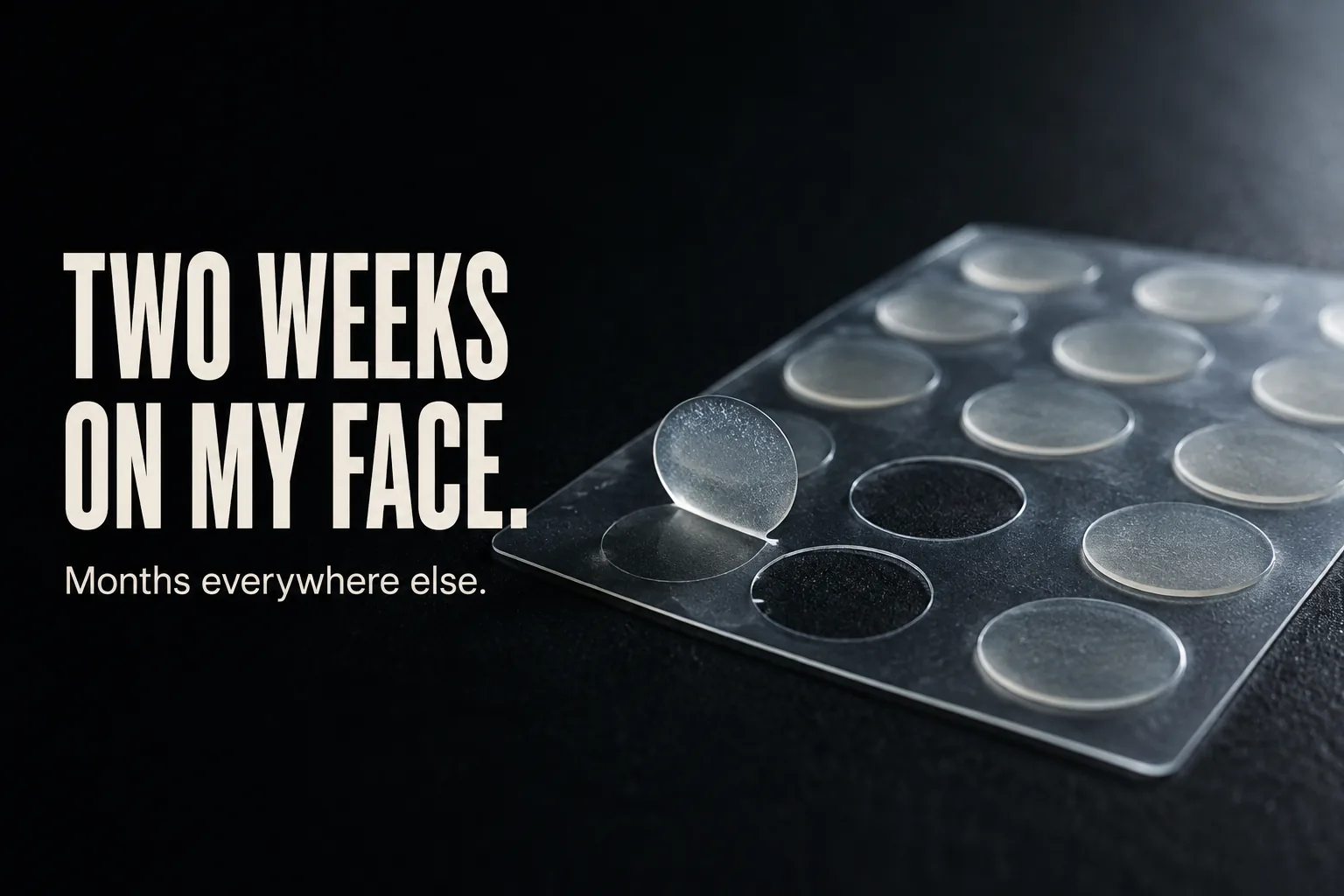
A pimple on my face leaves a dark mark that's gone in about two weeks.
An insect bite on my body leaves one that takes months.
Same person. Same skin. Same genes. The only real difference is that my face gets a routine every single day and the rest of me gets nothing at all.
I've thought about that a lot while writing this, because it's the closest thing to a fair test I've ever accidentally run on myself.
The short version: the mark left behind after a spot heals is a separate problem from the spot, and for us it's usually the bigger one. It fades on its own, but slowly — think months, not days. Sun makes it last longer, which makes sunscreen most of the answer. And the two things that make it worse are picking at it and attacking it with too many products.
The spot goes. The shadow stays.
You've had this happen. The pimple heals, the swelling goes down, and where it used to be there's a flat brown patch that just sits there. Not a lump anymore. Not sore. Just a stain.
That's your skin overreacting to being injured. Any inflammation — a spot, a bite, a cut, a shaving nick — can trigger it. The damage is over, but the color stays behind long after the thing that caused it is gone.
It matters because it changes what you're actually dealing with. Clearing a spot takes days. Clearing what it leaves behind takes months. If you judge your skin by what's in the mirror, most of what you're looking at isn't active spots at all. It's history.
This part genuinely is different for us
I'm careful on this site about claiming Asian skin is special, because a lot of what gets said about it doesn't hold up. When I looked into whether our skin is actually oilier, the honest answer was that it's unsettled.
This one is different. It holds up.
Dermatology research is consistent that these marks affect darker skin more often and more severely. And the reason isn't that we get worse acne — the research says acne itself works about the same way across ethnic groups. What differs is what it leaves behind.
One review puts it plainly: the distinguishing feature of acne in darker skin isn't the acne. It's the aftermath. Another goes further, and says that treating acne in darker skin is largely a matter of preventing and managing the marks rather than the spots.
That reframed the whole thing for me. The spot was never really the problem. The months afterward were.
It also explains why generic advice fails here. Most of it is written to clear spots fast, which is fine as far as it goes — and then stops, right at the point where our actual problem begins.
The test I accidentally ran on myself
My face gets cleanser twice a day, moisturizer, sunscreen, and now a toner and a serum. The rest of me gets soap in the shower and nothing else. Not once, not ever.
Marks on my face clear in about two weeks, consistently. Marks on my body from insect bites hang around for months.
I want to be honest about how much that proves, which is less than I'd like. Face skin and body skin aren't identical, an insect bite and a pimple aren't the same injury, and it's one person — me — which is the weakest evidence there is. If someone showed me this as proof of anything, I'd push back.
But the direction lines up with what the research says, and that's what makes me think it's real rather than coincidence. The part of me that gets daily protection recovers fast. The part that gets nothing takes months. It's hard to ignore when it's your own body.
How long this really takes
Longer than you want. Months is the normal unit here, and for some people it runs past a year.
I looked for a clean number to give you and there isn't an honest one — published ranges vary enormously, and quoting a precise figure would be pretending to a certainty nobody has. What I can tell you is that a large 2024 review described these marks as chronic once they've developed, and difficult to treat. That's the researchers' language, not mine.
My two weeks is not the normal experience and I won't pretend otherwise. I heal unusually fast. That's luck, not technique, and if I let you believe it's what a good routine buys you, I'd be selling you something.
Knowing that is what stops you quitting. Most men abandon a routine at six weeks because nothing's changed — when at six weeks, nothing was supposed to have changed yet.
Sunscreen is most of the answer
Here's the least satisfying true thing in this article.
The single most effective thing you can do about dark marks is stop the sun making them worse. Sun exposure deepens them and drags out how long they stay. Standard first-line management for these marks is a treatment product plus daily sun protection — and the sun protection half isn't optional garnish, it's doing a lot of the work.
I know how boring that is. You wanted a product that erases the mark, and the answer is the bottle I already told you to buy in the article about the damage I couldn't see.
But look at it this way: you're not just waiting for a mark to fade. You're in a race between your skin clearing it and the sun topping it back up. Sunscreen doesn't speed up the fading. It stops you losing ground while you wait.
Every day you skip it, you hand back progress you already made.
I squeeze my pimples. Don't copy me.
I'm going to be straight with you here because I'd rather be honest than tidy.
I squeeze my spots. I've found they recover faster when I do, and if one isn't ready I put a pimple patch on it overnight to draw out what's underneath.
And I'd still tell you not to do it.
The reason is everything I just explained. My skin heals unusually fast — two weeks where most people get months. That means I get away with something that would cost you far more than it costs me. Squeezing means more inflammation, and more inflammation means a darker mark that stays longer. On my face that's two weeks. On yours it could be most of a year.
There is one thing I never do, though, and this is the part I'd actually push on you. I don't go near a spot that isn't ready — the ones still swollen underneath the skin, where there's nothing to come out yet. Forcing one of those achieves nothing except damage, and it's the one situation where my own skin stops being fast. Those leave me a dark mark that runs noticeably longer than my usual two weeks.
That's the most convincing evidence I've got that any of this is real. The single time I break my own healing speed is the time I attack a spot that wasn't ready to go. If it's not ready, a patch overnight is the answer — it draws out what's underneath without you doing the damage yourself.
So this is one of those places where I'm not the right example to follow. The patch is the part worth copying. The squeezing is a habit I have, not a technique I recommend.
Attacking it makes it worse
The instinct, once you know the mark is the problem, is to go at it with everything available. Buy three products aimed at it and use them all at once.
Don't, and this is the part I'd most want you to take away.
That same 2024 review looked at 48 studies covering more than 1,300 people with darker skin, and its conclusion was blunt: there's a lack of robust efficacy across all the treatment options. Not one of them reliably works. Even the strongest performers only partially improved things for most people, and some of the aggressive clinical treatments actually made the marks worse in some patients.
The research also carries an explicit warning: be careful with these treatments, because irritating your skin can worsen the very marks you're trying to clear.
Read that twice, because it's the trap. The harder you attack a dark mark, the more you inflame the skin — and inflammation is what created the mark in the first place. You can spend real money making the problem last longer.
What I'd do instead is unexciting. Keep a routine that doesn't irritate you, wear sunscreen every day, leave the spots alone, and let time do the work it's going to do anyway.
I never bought a single product aimed at my marks. My routine was built around blackheads and the pores around my nose, which is what actually bothered me. The marks cleared as a side effect of having a routine at all.
If it's dented, that's not a mark
One thing worth separating out, because people mix them up.
A dark mark is flat. Run a finger over it and you feel nothing — it's a color change and nothing else, and color changes fade.
A scar has texture. It's dented, raised, or pitted, and it doesn't level out on its own no matter how long you wait or what you buy.
I don't have any scars, so I can't write about that from experience and I'm not going to pretend to. If what's bothering you has texture rather than just color, nothing in this article will fix it, and that's a conversation with a professional rather than a shopping decision.
What I'd actually tell you to do
Wear sunscreen every single day. This is most of the answer and it's the step people skip because it's boring.
Leave spots alone — and never touch one that isn't ready. More inflammation means a darker mark for longer. A spot still swollen under the skin has nothing to release yet, so squeezing it is pure damage, and it's the one thing that leaves even my skin marked for longer than usual. Put a patch on it overnight instead. I squeeze the ripe ones myself, and I've explained why you shouldn't copy that.
Don't buy three things to attack it. The evidence says none of them reliably work, and irritation makes it worse.
Measure in months. Six weeks of no change isn't failure, it's the normal timeline. Quitting at week six is the actual mistake.
Fix the routine, not the mark. Mine faded as a by-product of consistency, not because I bought anything aimed at them.
If you're starting from nothing, the three products are still where I'd begin, and the sunscreen is the one that matters most here.
And if you're not sure what your skin actually needs, the skin quiz takes a couple of minutes.
See you gents in the next post.
One note on transparency: no brand mentioned on this site is sponsoring us, and we don’t use affiliate links. Everything we recommend is something we’ve personally used. Nothing here is medical advice. If any of that changes, you’ll hear it from us first.
Don't miss the next one
New articles straight to your inbox. No spam, no fluff — just what actually works.
Free. Unsubscribe anytime.