
The Cheaper One Wasn't Real.
It was about a third cheaper than everywhere else sold it. That was the clue, and I read it as luck.

RayCo-Founder & Editor
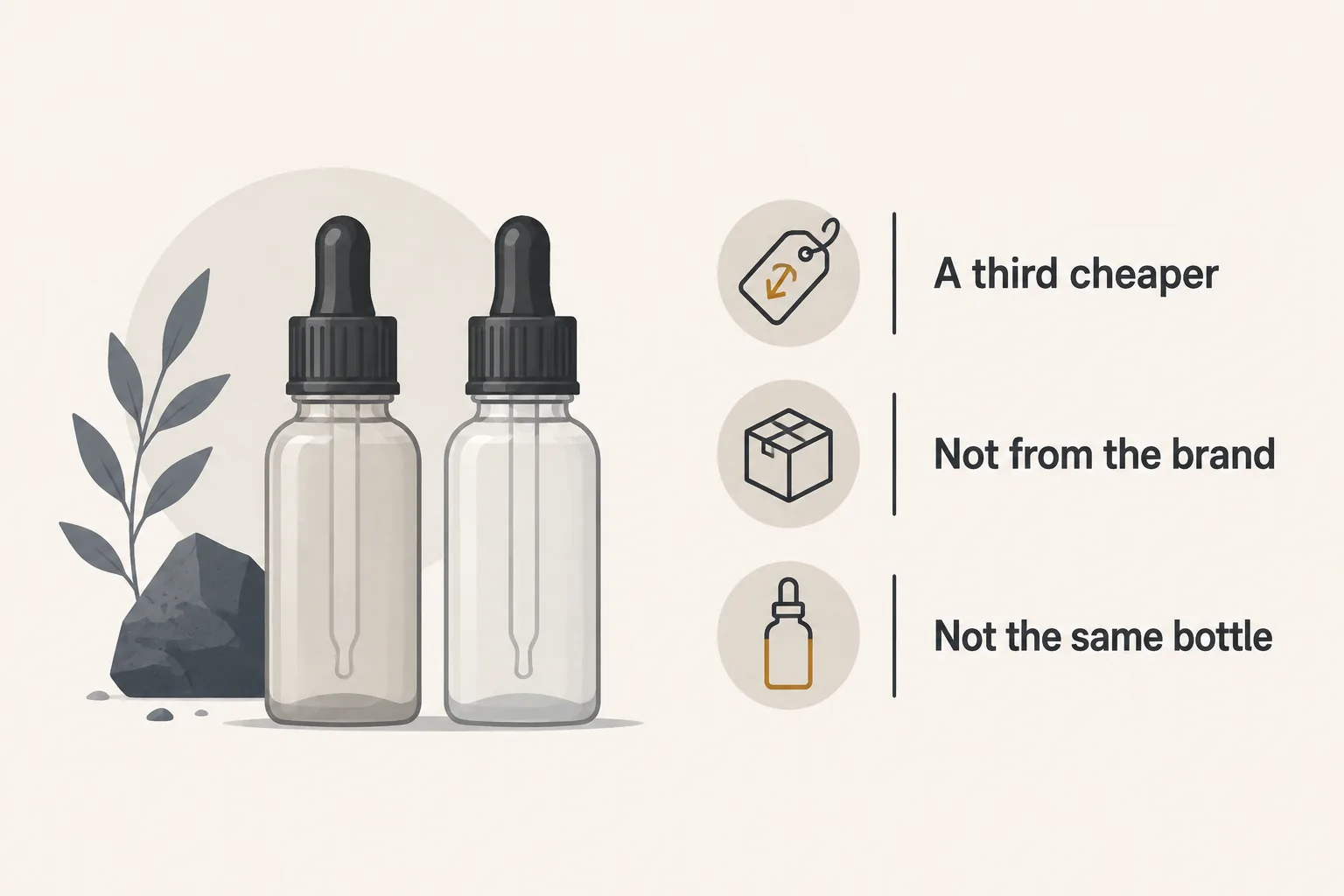
The short version: I bought an exfoliating serum about a third cheaper than everywhere else sold it, and it didn't feel like the one I'd used before. I think it was fake. I can't prove it, and that's rather the point — you usually can't. The rule I've followed since is boring and it works: buy from the brand's own store. A lower price from a seller you've never heard of isn't a bargain you found, it's the warning you ignored.
How do you end up with a fake?
You go looking for a better price, which is a completely reasonable thing to do.
I'd used the product before, so I wasn't buying blind. I knew what it cost. When I found it about a third below that, I read the gap as luck rather than as information, and I bought it.
A third is the interesting number, looking back. Not ninety percent off, which nobody believes. Just enough to feel like a win.
It didn't feel the same on my skin. That's the whole of my evidence and I want to be honest about how thin it is. I didn't send it to a lab. I have no batch number, no test, no proof. What I have is having used the real thing often enough to notice when something wasn't.
That's the uncomfortable part of counterfeits, and the reason they work. There is rarely a moment where you know. There's a slight wrongness, a shrug, and a bottle you stop reaching for.
How common is fake skincare, really?
Common enough that I stopped treating my experience as bad luck.
The FDA estimates that up to 20% of cosmetics sold online are counterfeit. One in five. Around 70% of beauty brands report finding fake versions of their products on digital marketplaces, and the industry puts its annual losses somewhere around $5.4 billion.
And it's getting worse specifically for the products this site recommends. Reported K-beauty counterfeit damages ran to $15.1 million across just nine months of 2025 — roughly twenty-four times the previous year. Korean skincare got popular, and the fakes followed the demand.
I'd assumed counterfeits were a handbag problem. They aren't.
What's actually in them varies, and none of it is reassuring. Testing on seized counterfeit cosmetics has turned up lead, arsenic and bacterial contamination. I'm not telling you that's what was in my bottle — I have no idea what was in my bottle, which is exactly the problem with not knowing where something came from.
Why is the cheap one cheap?
Two reasons, and telling them apart is most of the skill.
Sometimes it's geography, and that's legitimate. My moisturizer costs me about eight dollars. The same jar, bought in the United States, runs about twenty-two. Nothing dishonest is happening there — it's imported, it passes through more hands, and it's priced for a market that will pay more. I've written about Korean skincare being unusually good value, and I should say plainly that a large part of that value is where I happen to live rather than anything clever I did.
Wherever you're reading this, treat my prices as the floor rather than the target. If yours are higher, that isn't a discount you failed to find. It's a different market.
Sometimes it's a third-party seller undercutting the brand, and that's the one to worry about. This is my actual rule, and it's the only heuristic in this article: if it's cheaper and it isn't coming from the brand, that's a red flag rather than a find. The brand sets its own price. A stranger selling the same thing for less is either taking a loss, which nobody does for long, or selling something that isn't the same thing.
I've never found a good explanation for a big discount from a seller I couldn't name. I've stopped looking for one.
Where should you buy it, then?
From the brand's own website. That's what I do, every time, and it is duller than it sounds because it just works.
You're not paying a premium for it. That's the part people assume and it usually isn't true. The cleanser I use and recommend is $12 to $18 direct from the company that makes it. A widely sold Japanese sunscreen — one of the two I point people to in the sunscreen article — is about $16 direct from the brand. These aren't inflated boutique prices — they're just the price, without a middleman and without a question mark.
If the brand doesn't ship to you, the next best thing is a retailer that specializes in that category rather than a general marketplace. K-beauty specialists carry the actual product and are accountable to the brands they stock, in a way an anonymous marketplace seller isn't.
This matters most for the things you run every day. The three products I'd start anyone on get used twice a day for months at a time. A fake watch is a bad purchase you look at. A fake cleanser is something you put on your face six hundred times, and you'd be judging whether "the routine is working" using a product that isn't the one you think it is. That's not just money — it's the experiment ruined.
A general marketplace isn't automatically a problem, and I don't want to be unfair about it. Buying an item sold and shipped by the marketplace itself is a different proposition from buying the same listing from an unknown third-party seller. Amazon also ended its practice of pooling identical stock from different sellers in March 2026, which was the specific mechanism that made authenticity hardest to trace. The general point stands anyway: know who is actually selling it to you.
Do you need to check expiry dates?
I don't, and I want to be straightforward about that rather than give you advice I don't follow.
If I've bought from the brand, I assume the stock is fresh, and so far that assumption has held. Checking every batch code would be a level of diligence I have never once managed.
But notice that the assumption only works because of where I buy. The moment you're buying from a seller you can't identify, you've lost the thing that made the shortcut safe — and then expiry is the least of what you don't know. My laziness here is affordable because of the rule above it. Yours will be too, on the same condition.
What if you think you've got one?
Stop using it. That part isn't complicated, and it's the only decision you can make confidently.
Don't try to prove it. You won't. There's no test available to you, the seller will tell you it's genuine, and you'll spend two weeks arguing about a forty-dollar bottle. Report it to the platform and tell the brand — brands genuinely want to know, because the fakes damage them more than they damage you — and then let it go.
Don't conclude the product doesn't work. This is the expensive mistake, and it's the one I nearly made. If you've been running something that isn't what it claims to be, you have learned nothing about the real version. Write off the money, not the product.
And don't go back to the same seller for the replacement, which sounds obvious and is exactly what a discount will talk you into.
What I'd actually tell you to do
- Buy from the brand's own site by default. It is nearly always the same price, and it removes the entire question.
- Treat a surprise discount as information. If it's cheaper and it isn't the brand, ask why before you ask how much you saved.
- Check who the seller is, not just the listing. On a marketplace, "sold by" is the field that matters and it's the one nobody reads.
- Expect to pay more than I do. My prices are an accident of where I live. Yours are the real ones for your market, and a price near mine should make you suspicious rather than pleased.
- If it doesn't feel like it did last time, stop using it. You will not get proof. Your own hands are the only test you're going to run.
- Don't buy an unfamiliar brand at a suspiciously good price. With something you've never used, you have no reference point — which is precisely when a fake goes unnoticed.
None of this makes you safe. It makes you harder to sell to, which is the most that's available.
I was out about forty dollars and a few weeks of a routine that wasn't doing anything. That's the cheap version of this lesson, and I'd rather you had it secondhand.
Filed under
One note on transparency: no brand mentioned on this site is sponsoring us, and we don’t use affiliate links. Everything we recommend is something we’ve personally used. Nothing here is medical advice. If any of that changes, you’ll hear it from us first.
Don't miss the next one
New articles straight to your inbox. No spam, no fluff — just what actually works.
Free. Unsubscribe anytime.