
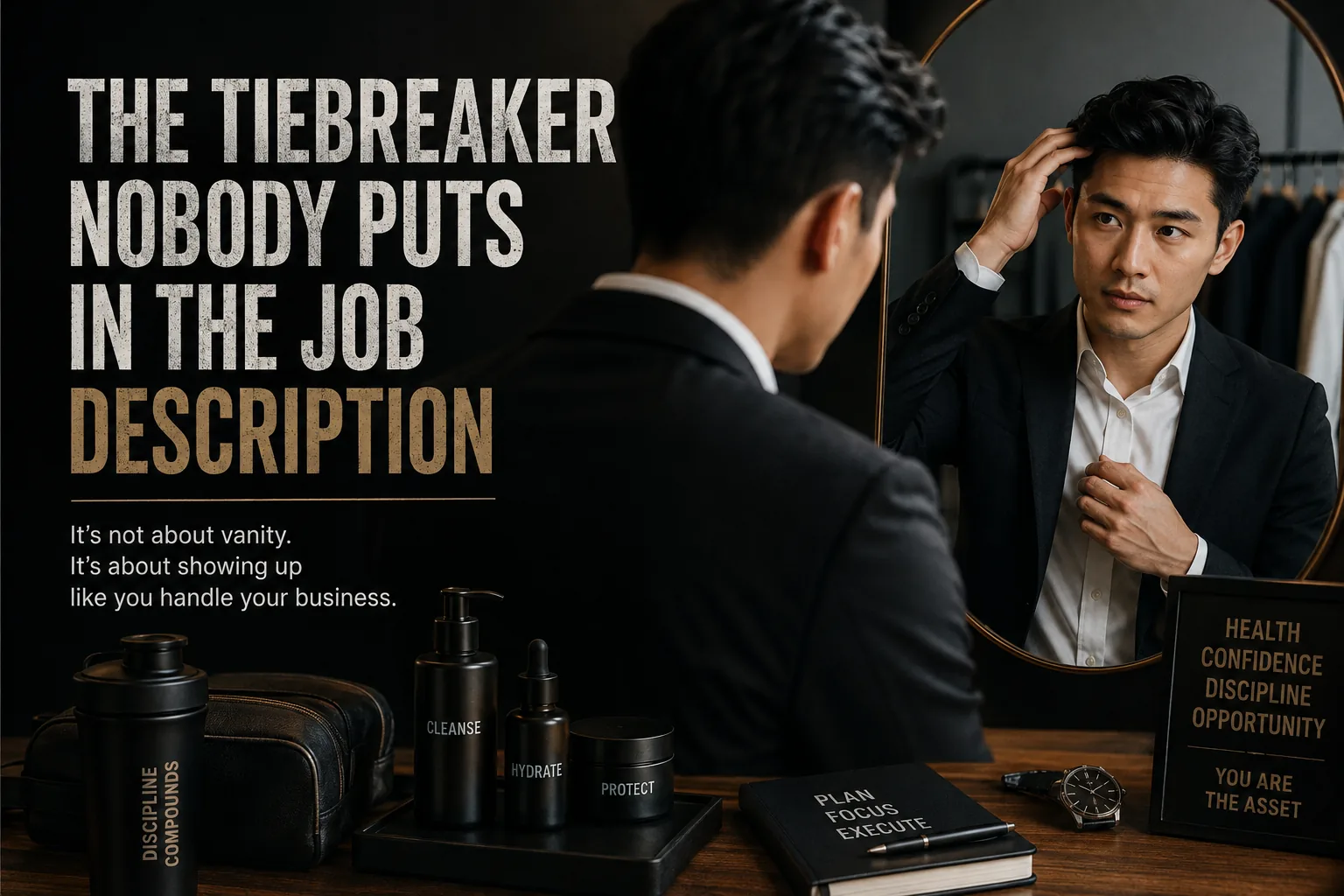
The Tiebreaker Nobody Puts in the Job Description
A hiring manager's blunt take on how he judges candidates stuck with me for weeks. Here's the uncomfortable truth underneath it — and what you can actually do about it.

RayCo-Founder & Editor
I read something a few weeks ago on one of those anonymous forums where people post the things they'd never say with their name attached.
I usually take those posts with a fistful of salt.
This one stayed with me.
A hiring manager wrote that he screens out candidates based partly on how they look after their physical health. His reasoning was simple:
If you can't take care of yourself, how can I trust you to take care of my business?
My first reaction was that it's an ugly thing to say.
I still think that.
It's the kind of judgment that can flatten a person into a single glance. And a glance tells you nothing about the illness someone is managing, the medication they're taking, the double shifts they're working, or the years of their life they've already given to something that mattered more than the mirror.
As a hiring practice, it's unfair. Depending on what exactly is being judged and where you live, it can also cross legal and ethical lines.
So no, I'm not here to defend him.
But I've been turning the idea over for weeks, and I can't pretend there isn't something underneath it worth talking about.
What people are actually doing when they judge you
Before I started The Asian Gentleman, my work put me across the table from a lot of senior people — including C-suite executives at companies large enough that their hiring decisions moved real money.
I asked a version of this question to a fair number of them. Usually casually. Usually over a meal.
The answers were remarkably consistent.
None of them said, "I judge people by their appearance."
Nobody says that out loud.
What they described instead was noticing details.
Did you turn up looking like you'd made an effort?
Does your shirt fit properly?
Do you look rested and present?
Do you carry yourself like someone who takes his responsibilities seriously?
Or do you look like you've been letting things slide?
And here's the honest mechanism, stripped of the moralising:
When someone doesn't have enough information about you, they look for whatever signals they can find.
That's not necessarily villainy. It's what human beings do under uncertainty.
A hiring manager has forty-five minutes and a stack of CVs that all claim the same things: team player, excellent communication skills, hardworking, adaptable.
So they look for evidence — any evidence — of what kind of person actually walks through the door.
Presentation is part of the first evidence they get.
Not because it's the most important thing about you.
Because it's one of the first things available.
Where this actually bites
Let's be precise about who this affects, because the internet loves to overstate these things.
If you're ten years into your field with a track record people can verify, your work speaks first and loudest.
Nobody passes on the best engineer they've ever interviewed simply because his skin looked tired.
But that's not where most of us are standing.
Think about the graduate going for an entry-level role in a competitive industry, where hundreds of applicants have functionally identical CVs.
Or the guy who's been solid but invisible for three years and is now competing with a colleague for one promotion.
Or the career-changer walking into a room where he's the least experienced person there.
In those rooms, the decision can genuinely be close.
And close decisions get made on tiebreakers.
Nobody writes the tiebreaker in the job description.
Nobody mentions it in the feedback email.
But when two candidates look similar on paper, the small signals suddenly matter more.
How you dress.
How you communicate.
How prepared you are.
How you carry yourself.
How you present yourself to the world.
That's not a conspiracy against you.
It's what happens when people have incomplete information.
It's the same reason you form an opinion about a restaurant before you've tasted anything. You notice whether the tables are clean. Whether the staff look organized. Whether the place feels cared for.
You haven't tasted the food yet.
You're still collecting signals.
The part you can actually control
Here's where I'll part ways with the man on the forum, because his framing leaves you nowhere useful to stand.
You can't control the standard you're being measured against.
You can't control an interviewer's biases.
You can't control whether someone walks into a room already carrying an opinion about what a successful man is supposed to look like.
Spending all your energy fighting those things is a slow way to go mad.
What you can control is the evidence you present.
And of all the levers available to a man who wants to look like he's on top of his life, one of the cheapest and simplest is the one many of us ignore completely:
Taking care of yourself.
Getting genuinely fit takes time.
Building a good wardrobe can cost money.
Building a strong career can take years.
But basic grooming and skincare? You can start today.
A simple routine takes minutes.
And while skincare isn't going to magically get you hired, looking well-groomed and cared-for can change how you present yourself — and, just as importantly, how you feel when you walk into the room.
That's the part I care about.
Not perfection.
Not looking like a model.
Not chasing some impossible standard of male beauty.
Just looking like you give a damn about yourself.
The real argument
I want to be careful here, because there's a sleazy version of this article that I'm not writing.
The sleazy version tells you that you're being judged, makes you anxious about it, then sells you the cure.
So let me put it the way I actually believe it:
You are the asset.
Not your CV.
Not your job title.
Not your bank balance.
Those things are downstream of you — your health, your energy, your discipline, your skills, your confidence, and the way you carry yourself into a room.
Most men will spend years optimising their CV and barely think about the man holding it.
And I think that's backwards.
Looking after yourself isn't vanity.
It isn't about winning some stranger's approval.
It's about becoming the kind of man who handles his business — starting with the business of himself.
The tiebreaker in the interview room is just a side effect.
The real return is that you stop being someone who constantly lets things slide.
You start exercising.
You start eating better.
You dress with intention.
You take care of your skin.
You get your finances in order.
You become more deliberate about the way you spend your time.
None of these things make you more valuable as a human being.
They simply reflect that you've decided to treat yourself like you're valuable.
And that mindset compounds.
Start with one thing you can change today.
The rest can come from there.
If you want more of this, join the list below.
New articles, straight to your inbox. No noise.
Start investing in yourself today. Nobody else is going to do it for you.
One note on transparency: no brand mentioned on this site is sponsoring us, and we don’t use affiliate links. Everything we recommend is something we’ve personally used. Nothing here is medical advice. If any of that changes, you’ll hear it from us first.
Don't miss the next one
New articles straight to your inbox. No spam, no fluff — just what actually works.
Free. Unsubscribe anytime.