
Shaving Without the Bumps
I've been shaving every morning for years and getting razor bumps on my neck. Writing this, I found out I was causing them.

RayCo-Founder & Editor
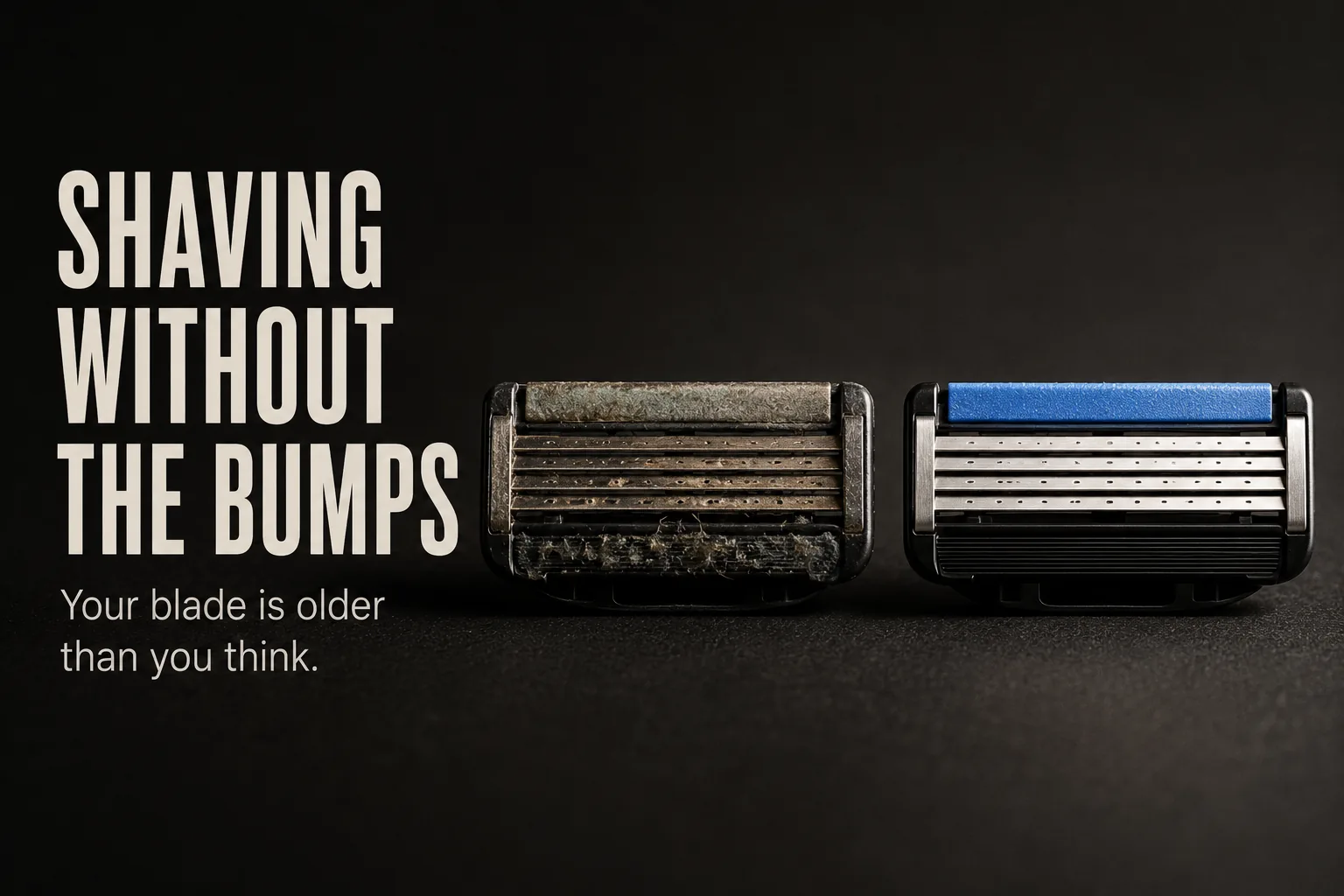
I get razor bumps on my neck. Not my jaw, not my cheeks — the neck, every time, in the same patch.
I've had them long enough to treat them as a fact of life. Something that comes with shaving every morning, like the shaving itself.
Writing this article, I found out I've been causing them.
The short version: if you shave daily, your blade needs changing every one to two weeks. Not every couple of months. A dull blade drags instead of cutting, so you press harder and go over the same patch twice, and that's what produces the bumps. I was doing this for years without connecting it to anything.
The first mistake, which I fixed years ago
When I started shaving I did it the way I assumed everyone did: wet the blade, drag it across my face, done. No gel, no cream, nothing in between the metal and my skin.
It went badly. Red, sore, irritated afterwards — every time, and I assumed that was just what shaving felt like.
Eventually the damage got obvious enough that I bought shaving gel, mostly out of frustration. The redness stopped almost immediately. That was the first thing I learned about shaving, and I learned it about a decade later than I should have.
If you're still shaving with a bare wet blade: that's your answer, and it's a cheap fix.
The mistake I only found writing this
Here's the one I'm less pleased about.
I shave every morning. I change my blade every couple of months.
The guidance for daily shaving is every one to two weeks. Manufacturers rate a cartridge at around five to seven shaves. I've been running somewhere near sixty.
And the specific consequence of a worn blade is exactly the thing I've been complaining about. A dull edge doesn't cut cleanly — it tugs. So you press harder, and you go back over the same patch a second and third time, and that repeated dragging is what produces bumps and burn. It happens even if everything else about your routine is right.
Mine was hiding in plain sight for years. I had the bumps, I had the cause, and I never put them together because a blade doesn't look dull. It just stops being sharp somewhere you can't see.
The reason nobody does this properly
It's money, and I don't think that gets said honestly enough. So here's the arithmetic that made me stop and look at my own habit properly.
A cartridge for a razor like mine costs somewhere in the region of four to five dollars. Prices move around and bulk packs bring it down, so treat these as ballpark figures rather than precise ones — but the shape of it holds.
What I currently do. One cartridge every couple of months. That's about six a year. Call it thirty dollars.
What I'm supposed to do. One a week, as a daily shaver. That's fifty-two a year. Call it two hundred and thirty.
That's not a small adjustment. It's roughly eight times what I've been spending, to fix a problem I'd stopped noticing. And when I put it that way, my two-month blade stops looking like laziness and starts looking like a fairly rational response to the price. I suspect most men reading this are making the same quiet trade.
Except it isn't a saving. You're paying full price for the razor and taking the irritation as your discount.
So I'm weighing the other way out, which is changing systems rather than buying more cartridges. A traditional safety razor takes flat double-edge blades that run somewhere between ten and fifty cents each and last about as many shaves as a cartridge does. Change one every week and you're spending something like twenty dollars a year.
Read that against the other two numbers and it's an awkward comparison. Doing it properly with a safety razor costs roughly what I'm already spending doing it badly with cartridges. The thing stopping me from changing blades weekly disappears entirely, because at twenty cents I'd stop hesitating.
I haven't made the switch, and I'm not going to recommend something I haven't used. What I'm still weighing is that a safety razor is less forgiving to learn on, and I'd be learning on a neck that already breaks out — which might be the worst possible place to experiment. If I do it, you'll get an honest write-up either way.
And I've been doing it in the wrong order
While I was at it, I checked something else.
I shave first, then cleanse. That's backwards. Warm water and a wash soften the hair and make it easier to cut, which is why the standard advice is to shave after you clean your face, or in the shower.
Slightly embarrassing detail: the skin quiz on this site has been telling readers to shave after cleansing for months. I wrote that advice. I have not been following it.
That one was free to fix, so I've fixed it — I've started washing my face before I shave rather than after. Too early to say whether it's helped the neck, but it costs nothing and the reasoning is sound. The blade is the harder question, and I'll come back to that.
Why this might affect you more than you've been told
Razor bumps happen when a shaved hair grows back into the skin instead of out of it, and then the skin reacts to it.
It's most associated with tightly curled hair, which curls back down into the skin instead of growing out — which is why nearly everything written about it is aimed at Black men, where it's most common by a wide margin.
What gets left out is who comes second. In the research on how common this is by group, Asian men rank second, above white men. The mechanism described is the same one: hair that curves as it regrows and turns back into the skin.
That's a pattern across a population, not a promise about your face — plenty of Asian men shave for forty years and never see a bump. But if you've had them and assumed you were unlucky or doing something uniquely wrong, you're not. You're just in a group nobody writes shaving advice for.
Coarse hair raises the odds too, regardless of how straight it is. Mine is very coarse and completely straight, and I get them anyway.
What I actually use
Razor: Gillette Fusion ProGlide. Nothing exotic, and the razor was never the problem — how long I kept the blade was.
Gel: Gatsby shaving gel. I picked it for a stupid reason that turned out to be a good one: it comes in a plastic container rather than a metal can, so it doesn't leave a rust ring on the shelf. A shaving gel you don't resent is a shaving gel you keep using.
Aftershave: Proraso White. This one's new — I'm testing it specifically for the neck bumps, so I can't give you a verdict yet. It's their sensitive line. I'll report back honestly either way once I've run it long enough to know.
What to actually do
Change your blade far more often than you think. Daily shaver: every one to two weeks. If it tugs rather than glides, it was already overdue. This is the single change most likely to fix your neck.
Never shave a dry face with a bare blade. Gel or cream, every time. Cheapest fix on this list.
Shave after washing, not before. Warm water first. Softer hair, easier cut, less dragging.
Go with the grain, not against it. Against the grain gets you closer and costs you more irritation. On a neck that already breaks out, it isn't a good trade.
One pass where you can. Every extra pass over the same patch is more scraping of skin you've already shaved.
Put something calming on afterwards — and nothing that stings. If it burns going on, that's not it working.
And if you're doing all of this and the bumps continue, that's a real condition with a name, and a doctor will have better options than an article will.
The honest summary
I've been writing about skincare while running a blade for ten times its life and shaving in the wrong order.
I'm not going to tell you I've solved both this week. The order I've already switched, and that one was free. The blade is a cost question I'm still working through, and I'd rather say that than pretend I flipped a switch the moment I found out.
That's the thing about a routine — the parts you never examine are exactly the parts causing problems, because you stopped seeing them years ago. Shaving is the step most men do daily and think about never, which makes it a good place to look.
If you want the rest of the routine that goes around it, start with three products and build from there.
See you gents in the next post.
One note on transparency: no brand mentioned on this site is sponsoring us, and we don’t use affiliate links. Everything we recommend is something we’ve personally used. Nothing here is medical advice. If any of that changes, you’ll hear it from us first.
Don't miss the next one
New articles straight to your inbox. No spam, no fluff — just what actually works.
Free. Unsubscribe anytime.