
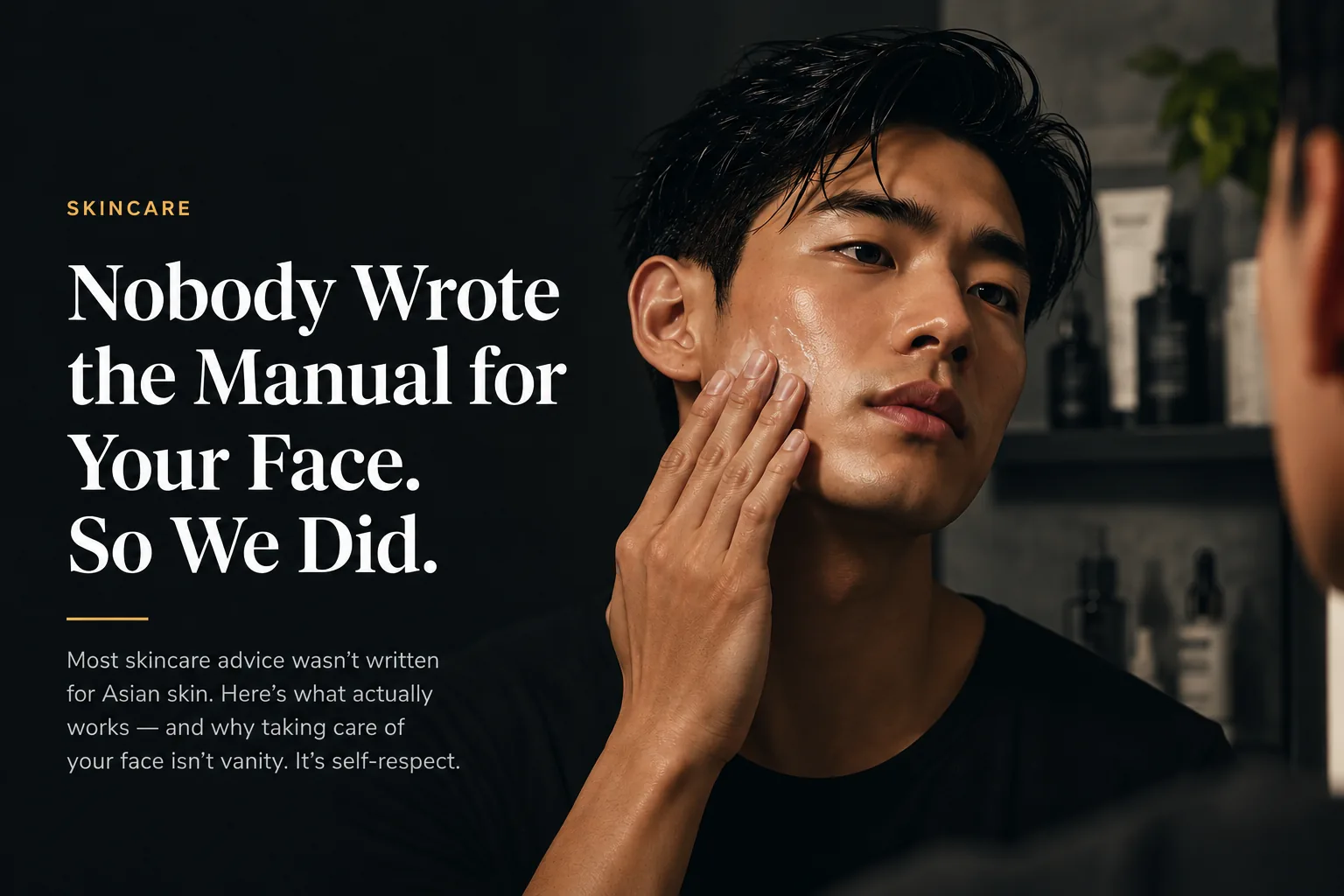
Nobody Wrote the Manual for Your Face. So We Did.
Most skincare advice wasn't written with Asian men's skin concerns in mind. Here's why the routines you tried never worked, what actually does — and why taking care of your face isn't vanity. It's self-respect.

RayCo-Founder & Editor
You know the feeling.
You're holding a cleanser that eight thousand glowing reviews swear by, and a quiet voice in the back of your head says: none of these reviews were written by anyone with your face.
You've tried the routines. Followed them properly. Somehow ended up shinier by lunchtime, with a dark mark on your cheek that outlived the pimple by half a year. You've read the grooming articles — beard oil, aftershave, moisturizers in rugged charcoal bottles — and felt like you were reading a manual for someone else's life.
Here's the thing nobody says out loud: you're not imagining it. The manual really was written for someone else.
The advice gap is real. It's not you.
A lot of mainstream skincare and grooming advice wasn't written with Asian men's most common skin concerns in mind. The advice isn't necessarily wrong. It just doesn't always address what you're actually dealing with.
Your skin has its own set of rules:
It holds a grudge. When a pimple heals, it can leave behind a dark mark that hangs around for months. That's called post-inflammatory hyperpigmentation, or PIH. In simple terms: the breakout is gone, but the evidence remains.
For many Asian men, that lingering pigmentation can be more frustrating than the original pimple. Most basic acne advice stops at "the breakout cleared." For us, that's halftime. The mark is often the real problem — and almost nobody talks about it.
It doesn't burn, so nobody warned you. You may tan easily and rarely experience obvious sunburn. Somewhere along the way, that can turn into "I don't really need sunscreen."
But UV exposure doesn't need to leave you looking like a lobster to affect your skin. It contributes to pigmentation, uneven skin tone and premature skin aging — and can make existing dark marks harder to deal with.
The most useful product for managing those concerns is often the one we were never told to buy.
It's oily where it counts. The shiny forehead and nose by midday — you know it well. The instinct is to scrub harder.
That's usually the wrong fight.
Harsh cleansers and aggressive scrubbing can irritate your skin and leave it feeling stripped, while doing little to solve the underlying problem. Your skin doesn't need to be punished into behaving. It needs to be managed consistently.
And here's the part the shelf never mentions: there is already a huge amount of skincare knowledge and product development coming out of Asia. Korea and Japan, in particular, have decades of experience developing skincare around concerns that are common among Asian consumers.
The knowledge exists.
What was missing was the translation — for the guy raised on Western grooming advice, standing in front of a shelf full of products wondering which one actually makes sense for his face.
That translation is what this publication is for.
Let's talk about the other thing
Because this was never only about skin.
If you grew up an Asian guy almost anywhere, you grew up doing quiet math about your own face. The leading men on screen rarely looked like you. The advertisements for "handsome" were calibrated to someone else. And somewhere along the way — maybe in your twenties, under bad lighting — you caught yourself in the mirror running the full audit: the skin, the features, the whole inherited package, measured against a standard that was never designed to include you.
We're not going to pretend a moisturizer fixes that. Anyone who tells you confidence comes in a bottle is selling you the bottle.
But here's what we've found to be true: confidence isn't a feeling you wait around to receive. It's a byproduct of evidence.
It builds from small, repeated proof that you're a man who handles his business — and your face is the most public piece of business you own.
A few minutes in the morning, a few at night. Not because you're vain. Because you're deliberate.
The same reason you wouldn't turn up to an important meeting in a wrinkled shirt: not shame — standards.
There's a generation of Asian men, all over the world, quietly figuring this out right now. Getting a simple routine down. Watching the dark marks fade after a couple of months and noticing that the mirror audit sounds different when the evidence changes.
Realizing that Asia has been developing skincare for decades — and that using products designed with Asian consumers in mind isn't becoming someone new.
It's claiming something that was already yours.
The standard you were measured against was never going to include you.
So stop measuring.
Build your own, and meet it daily.
Where to start (the honest version)
Forget the ten-step routines.
Nobody keeps a ten-step routine, and your skin doesn't need one to change visibly. It needs a few habits, done consistently:
1. Cleanse gently.
Wash your face in the morning and at night with a gentle cleanser. If your face feels tight and "squeaky" afterward, your cleanser may be too harsh.
Your skin shouldn't feel like it's been stripped clean.
2. Sunscreen, every morning.
If you're going to be exposed to daylight, make sunscreen part of your morning routine. This matters even more if you're dealing with dark marks or uneven skin tone.
And modern Asian sunscreens feel nothing like the greasy beach lotion you're imagining. Lightweight, comfortable formulas are one of the reasons Korean and Japanese sunscreens have become so popular.
3. One targeted product.
Choose one product for your main concern — acne, dark marks, oiliness, texture, whatever matters most to you.
Not five.
The fastest way to ruin a new routine is to overload it in week one, irritate your skin, get confused about what's causing what, and quit by week three.
Start simple.
Give it time.
If you want the exact products to start with, we've broken down all three.
A couple of months of consistency, and the mirror starts giving you different data.
Built for your skin, finally
Everything we publish starts from one premise: your face isn't a problem to be corrected.
It's a design to be understood.
And once you understand it, most of what confused you about skincare stops being confusing.
Want to know where your skin should start — your oil pattern, your main concern, your actual patience level?
Nine questions. No fluff. A starting routine built around your face — not adapted as an afterthought.
Filed under
One note on transparency: no brand mentioned on this site is sponsoring us, and we don’t use affiliate links. Everything we recommend is something we’ve personally used. Nothing here is medical advice. If any of that changes, you’ll hear it from us first.
Don't miss the next one
New articles straight to your inbox. No spam, no fluff — just what actually works.
Free. Unsubscribe anytime.